


Your wrist is an essential part of your hand and if immobilized, especially due to injury, it makes it difficult to perform everyday tasks. If an injury to the wrist happens you may need to wear a wrist hand orthosis to prevent your wrist from moving. In this article, we’ll explore key things you need to know about wrist hand orthosis.
What is Wrist Hand Orthosis?

An orthosis is a device that supports a certain part of the body. Thus, as the name suggests, a wrist immobilization orthosis supports the wrist.
Also known as a wrist immobilization orthosis, a wrist hand orthosis supports the joints, ligaments, nerves, bones, and tissues that affect wrist mobility. Generally, wrist immobilization orthosis provides support by limiting wrist movement while allowing the fingers to move freely.
There’s also a special wrist hand orthosis called a wrist hand finger orthosis that reaches the fingertips and thumb.
What Injuries and Conditions Can a Wrist Hand Orthosis Treat?
A wrist hand orthosis (or, orthoses, which is plural) can help to treat wrist injuries and alleviate wrist pain. It can benefit people with injuries and conditions such as:
Carpal tunnel syndrome
Carpal tunnel syndrome is a condition caused by irritation to the median nerve due to excessive pressure build up. The median nerve transmits signals and information to the thumb and fingers, excluding the little finger. Carpal tunnel syndrome is characterized by numbness in the thumb and fingers and weakness in the wrist, especially affecting grip strength.
Wrist sprains and fractures
A wrist sprain is the damage or injury of ligaments that stabilize the wrist bones, whereas a wrist fracture is a break in one or more wrist bones. Wrist sprains and fractures are characterized by pain, swelling, bruising, and weakness. Depending on the severity of the sprain or fracture, you can experience varying levels of pain, and the treatment can vary from immobilizing the wrist for a period of time to surgical intervention.
Wrist tendinitis
Wrist tendinitis is a condition caused by inflammation in the tendons that connect the bones in the forearm to those of the hand, leading to weakness, swelling, stiffness, and pain, especially when performing repetitive wrist movements or lifting objects.
Rheumatoid arthritis and osteoarthritis
Rheumatoid arthritis and osteoarthritis are types of arthritis characterized by joint pain and stiffness. Rheumatoid arthritis is an autoimmune disorder where the immune system attacks the joint tissues and lining, leading to inflammation, tissue erosion, and eventually, joint deformity. Osteoarthritis is a degenerative disorder where the protective cartilage and tissues that cover the joints wear down, especially with age, making it common in the elderly.
Radial nerve palsy
Radial nerve palsy is a condition resulting from the compression or damage of the radial nerve, which runs through the entire arm and is responsible for the movement of the wrist extensors and thumb muscles, among other functions. Damage to or compression of the radial nerve leads to weakness, pain, and loss of function to the fingers, wrist, and hand.
Wrist drop
Wrist drop is a condition that paralyzes the wrist and the extensor muscles, causing the wrist to droop. As a result, wrist drop greatly limits hand functionality because it renders tasks with the fingers pointed upwards pretty much impossible.
Why Wear a Wrist Hand Orthosis?
A wrist hand orthosis is primarily worn to provide support to the wrist after injury or to treat and manage medical conditions. In addition, here are some more aims of wrist hand orthosis treatment:
- Support the wrist after surgery
- Protect the hand and wrist after an injury
- Alleviate pain arising from conditions such as wrist tendinitis and arthritis
- Limit wrist movement
- Allow light use of the injured wrist
- Improve grasp strength
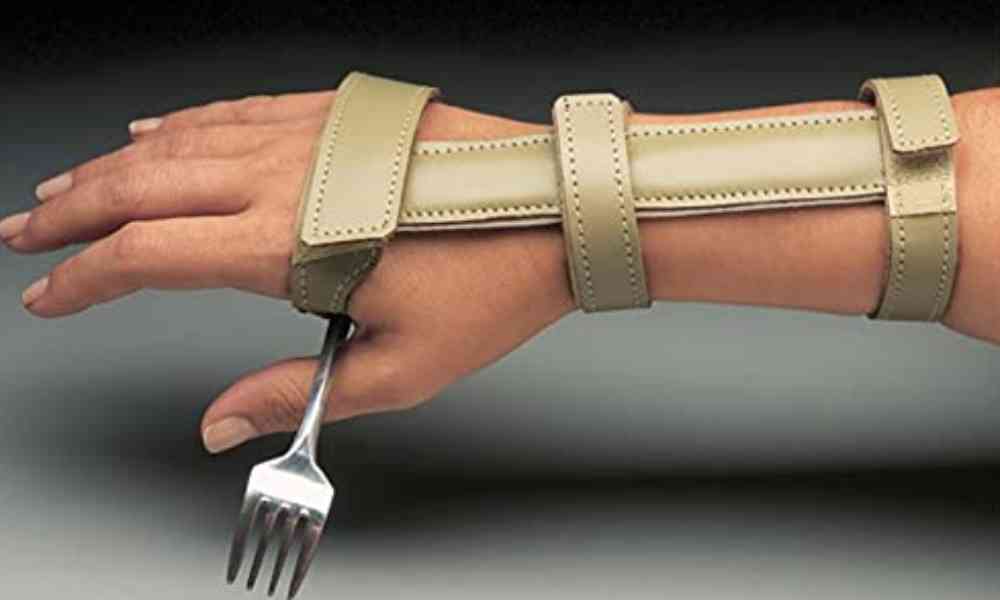
This wrist support is ideal for spastic or weak wrists following an injury.
Features a leather cuff with a pocket built in to aid in using eating utensils.
What Type of Wrist Hand Orthoses Are There?
Static Orthosis
A static orthosis is designed for stability, protection, and support, and its primary purpose is for immobilizing the joints. Static wrist hand orthoses are excellent for conditions such as wrist drop, wrist sprains and fractures, radial nerve palsy, and rheumatoid arthritis and osteoarthritis, especially during post-operative recovery.
Static Progressive Orthosis
A static progressive orthosis is designed for the gradual increase in motion in the wrists. The design allows the orthosis to provide a pressure and stretch range, which can be adjusted after the patient gets used to the initial range.
A static progressive orthosis is excellent for all conditions except rheumatoid arthritis and osteoarthritis and especially not when the recovery process calls for complete immobilization. You need to consult your doctor or physical therapist after meeting your current motion range goals and before adjusting the orthosis further.
Dynamic Orthosis
Dynamic orthoses are designed to increase motion and for functional support of the wrist. The functional dynamic orthoses are designed to provide support and protection to parts of the wrist during recovery and are applicable for parts that need gradual adjustments after injury, surgery, or due to conditions such as carpal tunnel syndrome, wrist sprain and fracture, wrist drop, and radial nerve palsy.
Dynamic orthoses for motion, on the other hand, are designed to stretch stiff parts of the wrists. These orthoses are designed for conditions that call for constant stretch before the wrist is fully functional such as wrist tendinitis, wrist sprain, wrist drop, and carpal tunnel syndrome.
Final Word on Wrist Hand Orthosis
A wrist hand orthosis can be useful in the treatment of many conditions and injuries. If you’re considering using a wrist hand orthosis for any of the conditions or injuries mentioned above, consult your physical therapist or doctor.